
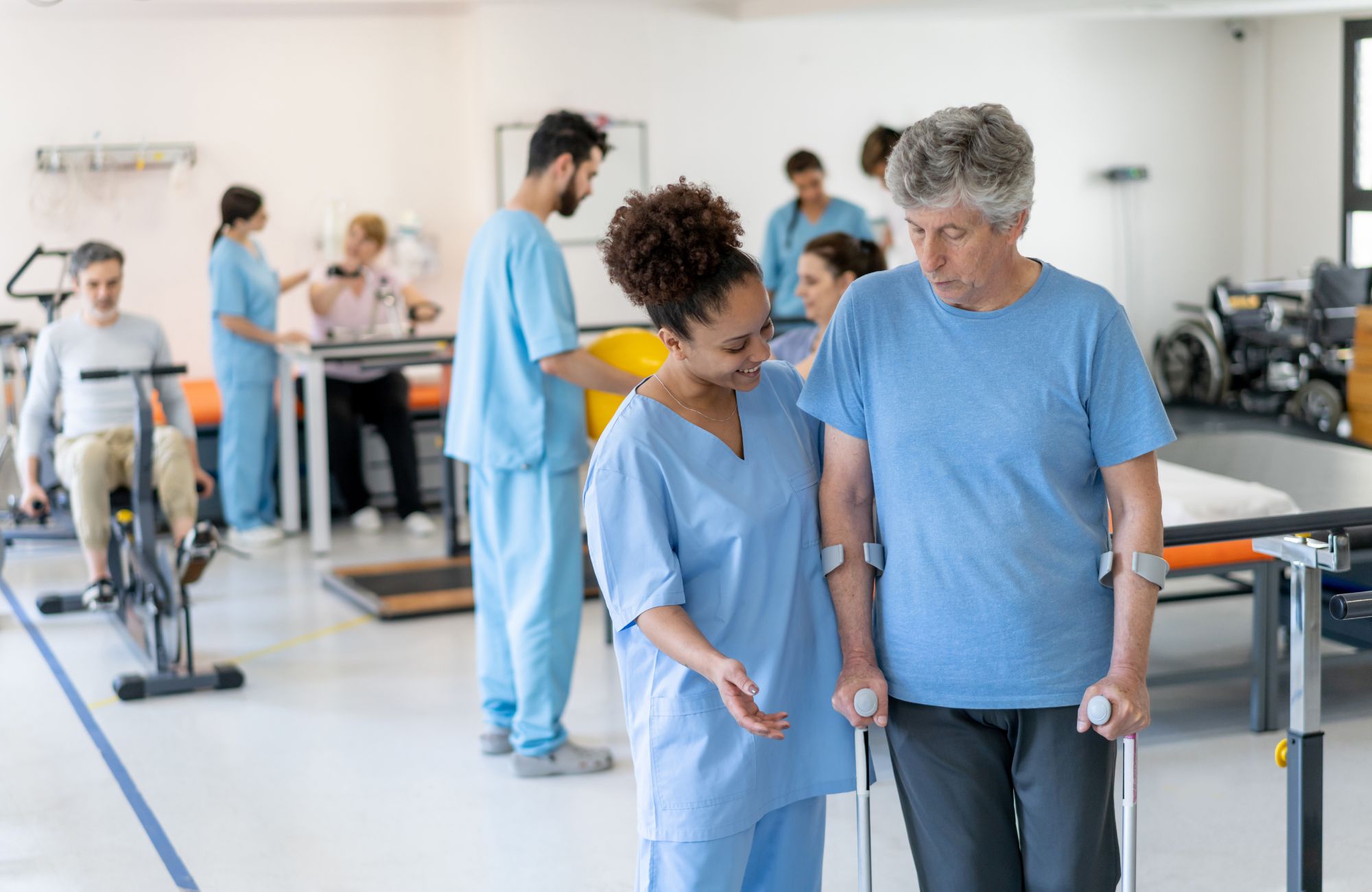
A fall prevention program in a skilled nursing facility is an interdisciplinary system for identifying resident risk factors, implementing individualized interventions, responding to incidents, and tracking whether those interventions reduce falls over time. It is not a single balance exercise, screening form, or nursing protocol. An effective program connects nursing, rehabilitation, medical oversight, pharmacy review, environmental safety, and quality improvement.
Falls are the leading cause of injury among adults age 65 and older, and more than 14 million older adults report falling each year. In skilled nursing, the impact extends beyond the immediate injury. Falls can affect resident mobility, confidence, independence, hospital utilization, and survey findings. Falls with major injury can also affect publicly reported quality measures and the facility’s Five-Star Quality Measure rating.
Consistent rehabilitation staffing is a core part of that system. Qualified physical therapists, occupational therapists, and therapy assistants help facilities complete timely mobility evaluations, identify functional risk, recommend assistive devices, deliver evidence-based training, and measure whether interventions are working.
A skilled nursing fall prevention program is a facility-wide quality and safety process designed to prevent avoidable falls while supporting each resident’s mobility, independence, and well-being. It combines universal screening with a comprehensive assessment for residents identified as high risk.
The program should address more than balance. Falls among older adults often involve several connected risk factors, including muscle weakness, gait changes, chronic health conditions, cognitive impairment, medication effects, continence needs, fear of falling, environmental hazards, and improper medical equipment use. AHRQ describes nursing facility fall prevention as an interdisciplinary quality improvement initiative built around assessment, individualized care planning, intervention, monitoring, and staff education.
A complete program typically includes:
Not every fall can be prevented. The facility’s responsibility is to show that known and foreseeable risks were identified, evaluated, addressed, and monitored.
Falls are both a resident safety concern and a measurable indicator of nursing home quality. CMS publicly reports the percentage of long-stay residents who experience one or more falls with major injury. This measure is included among the long-stay quality measures used to calculate the Five-Star Quality Measure rating.
The falls-with-major-injury quality measure and F689 address related but different concerns. The quality measure reflects reported outcomes among long-stay residents. F689 examines whether a facility identified hazards and resident risks, provided adequate supervision and assistive devices, implemented appropriate interventions, and monitored whether those interventions worked.
CMS maintains separate Five-Star ratings for health inspections, staffing, and quality measures, which contribute to a nursing home’s overall rating. The falls-with-major-injury measure looks at incidents involving long-stay residents during the applicable reporting and look-back period.
This does not mean every resident fall automatically lowers a star rating or results in a citation. However, rising fall rates, repeat falls, major injuries, or inconsistent documentation may signal weaknesses in the facility’s assessment and prevention systems.
F689, Free of Accident Hazards/Supervision/Devices, requires a facility to keep the resident environment as free from accident hazards as possible and provide adequate supervision and assistance devices to prevent avoidable accidents.
CMS guidance describes four main responsibilities:
A survey concern may develop when a facility identifies that a resident needs transfer assistance, supervision, adaptive equipment, or another intervention but does not consistently provide it. Exposure may also arise when staff fail to reassess the resident after a fall, follow the care plan across shifts, provide a properly fitted assistive device, or respond to a known environmental hazard.
For SNF administrators and Directors of Rehabilitation, survey readiness therefore depends on both clinical judgment and operational follow-through. Documentation should show a clear connection between the identified fall risk, the selected intervention, staff implementation, resident response, and any later care plan revision.
Consistent therapy coverage allows an SNF to identify mobility-related risks early and respond before isolated issues become repeated incident patterns. When physical therapist positions remain vacant or coverage becomes unpredictable, fall prevention work may become reactive rather than preventive.
A rehabilitation staffing gap can affect:
A staffing shortage does not automatically cause a fall. However, it can create process gaps that later appear in incident data. A facility may see longer evaluation wait times, repeated falls during the same daily activity, inconsistent device use, or interventions that remain on a care plan without evidence that they were reviewed.
Facilities can use physical therapist staffing services to maintain access to licensed professionals when vacancies, leaves, census changes, or recruitment delays affect rehabilitation coverage.
A fully staffed fall prevention program assigns clear responsibility while keeping the process interdisciplinary. Physical therapists do not manage every risk factor, and nurses should not be expected to address complex gait or equipment concerns without rehabilitation input.
The following is an example operating structure. Exact treatment frequency should remain based on the resident’s evaluation, orders, plan of care, payer requirements, and individual needs.
| Role | Fall prevention responsibilities | Typical program involvement |
| Physical therapist | Evaluates gait, balance, strength, transfers, walking tolerance, and assistive device needs | At referral, after significant mobility changes, after relevant falls, and during scheduled reassessment |
| Physical therapist assistant | Carries out the PT plan, reinforces safe movement, and documents resident response | Based on the established therapy plan and supervision requirements |
| Occupational therapist | Evaluates daily living tasks, toileting, cognition, environmental interaction, positioning, and adaptive equipment | When falls relate to ADLs, cognition, bathroom tasks, wheelchair use, or environmental access |
| Occupational therapy assistant | Implements interventions for daily activities, transfer routines, and adaptive equipment use | Based on the OT plan and supervision requirements |
| Nurses and nurse aides | Complete screening, observe condition changes, implement supervision levels, document incidents, and follow care plan instructions | Every shift |
| Medical and pharmacy team | Reviews acute conditions, medications, dizziness, sedation, blood pressure changes, vision concerns, and other medical risks | At admission, during medication review, and after relevant changes or falls |
| DOR and facility leadership | Review coverage, referrals, missed visits, trends, training needs, and program implementation | Weekly operational review and routine quality meetings |
| Interdisciplinary team | Reviews repeat falls, intervention effectiveness, and required care plan changes | After significant incidents and at established fall-review intervals |
AHRQ’s nursing facility program recommends screening on admission and at quarterly, annual, and change-of-condition points. It also calls for an immediate response and careful investigation after a fall, followed by long-term monitoring and care plan revision.
Qualified physical therapists contribute objective mobility data that help the interdisciplinary team move beyond a general “high-risk” label. Their evaluation can identify whether a resident’s risk of falling is primarily connected to weakness, gait instability, impaired balance reactions, pain, reduced endurance, poor device use, or difficulty completing transfers.
A PT assessment may examine:
The therapist’s findings should become part of the broader comprehensive assessment. Cognitive status, mental health, medications, continence, vision, acute illness, and environmental risks require input from nursing, medical staff, pharmacy, occupational therapy, and other team members.
Standardized tools help physical therapists establish a mobility baseline and track changes over time.
No single score should determine the full fall prevention plan. Therapists interpret results alongside the resident’s diagnosis, assistance needs, cognitive status, device use, incident history, and daily activities.
Falls are rarely caused by one isolated problem. A comprehensive program examines intrinsic, extrinsic, and operational risk factors.
These may include:
Fear of falling also deserves attention. A resident may begin avoiding walking, therapy, dining areas, or social activities. This reduced activity can increase deconditioning and further limit mobility and independence.
Within an SNF, environmental review may include:
These are facility safety concerns, not general home modification tips. Any simple modifications should correspond to the resident’s assessed needs and be documented in the care plan.
Therapy interventions should match the resident’s identified limitations rather than rely on the same exercise list for every high-risk resident.
| Therapy intervention | What it addresses | Facility fall-program value |
| Balance exercises | Static stability, weight shifting, reaching, and reactions to movement | Helps residents respond more safely during transfers and standing activities |
| Gait training | Step length, foot clearance, turning, device use, and walking pattern | Addresses mobility problems observed during walking or incident review |
| Strength training | Hip, knee, ankle, and trunk weakness | Supports transfers, standing, and recovery from a loss of balance |
| Transfer training | Bed, chair, toilet, and wheelchair movement | Helps standardize the assistance and cues required from staff |
| Dual-task training | Walking or balance while attention is divided | Prepares appropriate residents for real daily activities |
| Assistive device training | Fit and safe use of walkers, canes, wheelchairs, and adaptive equipment | Reduces risk created by incorrect equipment use |
| Functional activity training | Toileting, dressing, reaching, and other daily living activities | Connects fall prevention to the situations where risk occurs |
| Staff and resident education | Carryover of transfer, mobility, and equipment instructions | Supports consistent implementation across shifts |
Effective exercises should challenge the resident enough to support progress without creating unnecessary risk. The physical therapist or occupational therapist determines the appropriate level of assistance, training environment, and progression.
Administrators should not wait for an annual quality report to identify problems. Fall data can reveal whether the facility’s staffing and intervention systems are functioning consistently.
Potential warning signs include:
These patterns do not prove that a therapy vacancy caused the incidents. They do indicate where leadership should review referral access, staff availability, care plan communication, training, and follow-through.
AHRQ recommends tracking details such as the location, time, activity, and circumstances surrounding each incident. Reviewing these details helps organizations identify patterns that may be missed when leadership looks only at the total number of falls.
SNFs should track both fall outcomes and whether prevention steps are being completed. Useful measures include falls per 1,000 resident-days, falls with injury, repeat fallers, post-fall reassessment completion, therapy evaluation delays, missed visits, care plan updates, and staff training compliance.
Leadership should also review whether each resident’s risks were identified, the care plan matched those risks, interventions were followed across shifts, and the plan was revised when needed. AHRQ notes that fall care plans should be reviewed and adjusted when current interventions are not preventing additional falls or injuries.
A sustainable fall prevention program requires leadership support, reliable staffing, clear communication, and ongoing staff education. Policies alone will not reduce falls when employees do not know the resident’s current assistance level or cannot access the professionals needed to complete evaluations and training.
SNF administrators and DORs can strengthen implementation by:
Facilities may also benefit from professionals with focused experience in elderly rehabilitation and therapists who understand the mobility, chronic condition, and daily living needs common among geriatric residents. A geriatric physical therapist can support older adult mobility, functional independence, and fall-risk management as part of the facility’s interdisciplinary team.
A strong fall prevention program depends on more than a written policy. Facilities need qualified rehabilitation professionals who can complete timely evaluations, deliver individualized interventions, document measurable findings, train staff, and participate in interdisciplinary follow-up.
Flagstar Rehab provides flexible staffing and placement support for skilled nursing facilities that need licensed rehabilitation professionals. Temporary, contract, and direct-hire options can help facilities maintain consistent therapy coverage during vacancies, onboarding periods, and other staffing gaps.
No. A fall does not automatically establish noncompliance. Surveyors examine whether the facility identified known and foreseeable risks, provided appropriate supervision and assistive devices, implemented the care plan, and monitored whether the interventions were effective.
AHRQ’s nursing facility fall management model includes screening at admission, quarterly, annually, and after a change in condition. A resident should also receive immediate evaluation and investigation after a fall. Facilities must align their process with current CMS requirements, state rules, clinical judgment, and their own policies.
Leadership responsibility may sit with nursing, quality, or another designated coordinator, but the program should remain interdisciplinary. Administrators, Directors of Rehabilitation, nurses, nurse aides, rehabilitation professionals, medical staff, pharmacy, and environmental services all contribute different information needed to prevent falls.
A physical therapist evaluates mobility, balance, strength, gait, transfers, endurance, and assistive device use. The therapist then develops and monitors interventions based on the resident’s functional limitations and goals. Flagstar places physical therapists in facilities but does not perform the clinical evaluation itself.
The 5 P’s commonly refer to pain, potty, position, possessions, and pathway. Staff may use them as prompts during rounding, but the framework does not replace a comprehensive assessment or an individualized care plan.
Staffing shortages may delay evaluations, reduce treatment consistency, limit participation in post-fall reviews, and leave less time for equipment training or reassessment. Facilities can reduce these coverage gaps by using temporary, contract, or direct-hire therapy staffing support.