
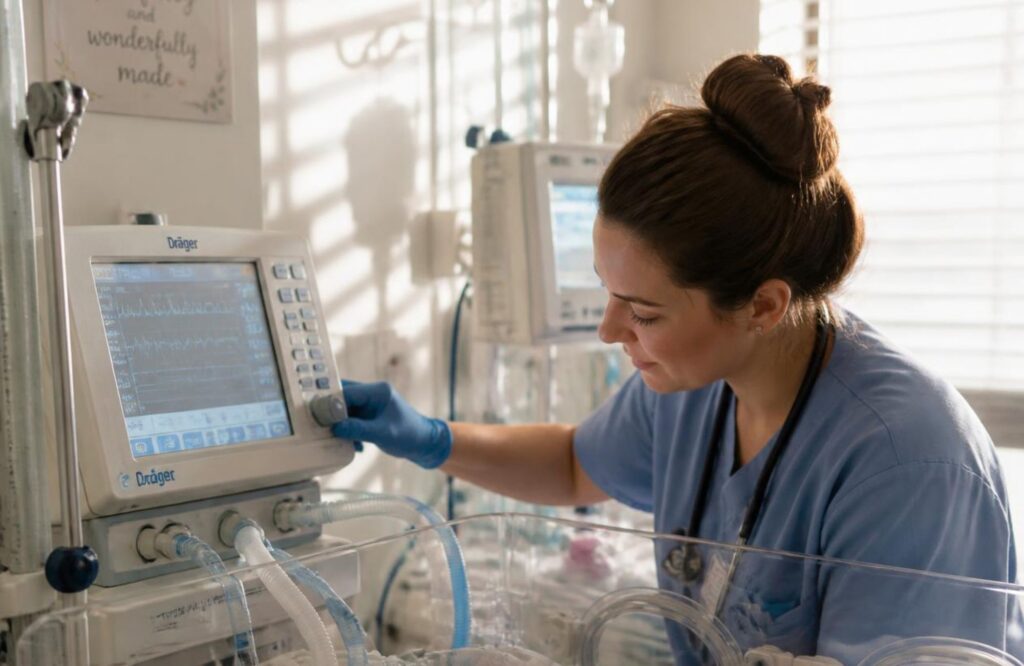
A NICU respiratory therapist is a credentialed respiratory care professional, typically state-licensed, who supports premature and critically ill newborns with breathing, airway, and oxygen needs. The therapist may manage ventilators, provide respiratory treatments, assist at high-risk deliveries, and work with neonatologists and nurses to monitor each newborn’s response to care.
NICU respiratory care requires precision because neonates have small airways and developing lungs. A minor change in oxygenation, respiratory rate, or heart rate may require a fast response from the medical team.
The exact duties depend on the hospital, NICU level, state practice rules, and physician orders. Some respiratory therapists focus on bedside patient care. Others may also work as part of a neonatal transport team.
What Does a NICU Respiratory Therapist Do?
A NICU respiratory therapist assesses breathing, manages respiratory support, and monitors newborns with respiratory issues. Common duties include oxygen therapy, mechanical ventilation, blood gas analysis, airway care, medication administration, neonatal resuscitation, documentation, and communication with physicians, nurses, and other members of the critical care team.
A therapist may begin a shift by reviewing the infants assigned to them. This review may include current oxygen needs, ventilator settings, recent blood gas results, respiratory medications, and changes from the previous shift.
Core duties may include:
- Performing a cardiopulmonary assessment
- Checking respiratory rate, heart rate, and oxygen saturation
- Using pulse oximetry to monitor oxygenation
- Setting up and checking respiratory equipment
- Managing noninvasive and invasive respiratory support
- Giving ordered respiratory medications
- Assisting with airway procedures
- Monitoring each newborn’s response to treatment
- Recording respiratory interventions
- Following hospital procedures and safety protocols
- Reporting changes to the physician and nurses
- Supporting the infant’s comfort and well-being
A NICU respiratory therapist provides respiratory care within the therapist’s legal scope of practice. The therapist follows the physician’s orders, clinical guidelines, and hospital policy.
The therapist does not work alone. NICU patient care depends on close teamwork among respiratory therapists, neonatologists, nurses, pharmacists, and other clinical staff.
NICU positions may require recent neonatal experience, active licensure, specialized equipment knowledge, and specific shift availability. Flagstar Rehab provides respiratory therapist staffing services that connect healthcare organizations with qualified clinicians for temporary, per-diem, contract, and direct-hire needs.
How Respiratory Therapists Support High-Risk Deliveries
Respiratory therapists may attend high-risk deliveries when a newborn could need breathing or airway support. Before delivery, the therapist checks masks, oxygen equipment, suction tools, airways, and ventilation devices.
During delivery, the therapist may assist with positive-pressure ventilation and other life-support measures. The infant’s breathing, heart rate, oxygen saturation, and response to ventilation guide the team’s actions.
If the newborn needs continued critical care, the therapist may help prepare respiratory equipment for transport to the NICU. A transport respiratory therapist may also support neonatal or pediatric patients during transfers between hospitals.
Respiratory therapists exploring neonatal and critical care employment can review registered respiratory therapist jobs that fit their current training and experience.
Hospitals hiring for NICU and neonatal respiratory roles may prioritize candidates with recent delivery-room experience, neonatal resuscitation education, and demonstrated competency with positive-pressure ventilation, airway equipment, and emergency respiratory support. Therapists without this experience may need supervised training before taking independent delivery assignments.
What NICU Conditions Should Respiratory Therapists Understand?
NICU respiratory therapists need working knowledge of common neonatal respiratory conditions because each diagnosis may affect oxygen delivery, airway support, ventilation settings, monitoring, and communication with the medical team. Employers may assess whether candidates understand how these conditions influence daily respiratory care, even though diagnosis and treatment decisions remain physician-led.
Common conditions include:
- Respiratory distress syndrome: Therapists may support premature newborns who need surfactant-related care, oxygen therapy, CPAP, or mechanical ventilation.
- Apnea of prematurity: Candidates should understand respiratory monitoring, facility protocols, and noninvasive support used when premature infants experience breathing pauses.
- Bronchopulmonary dysplasia: Therapists may manage long-term oxygen needs and monitor infants who require extended respiratory support.
- Meconium aspiration syndrome: The role may involve airway support, ventilation, oxygenation monitoring, and rapid response after delivery.
- Persistent pulmonary hypertension of the newborn: Candidates may need experience with advanced oxygenation strategies and inhaled nitric oxide systems.
- Neonatal pneumonia or infection: Respiratory therapists monitor changing oxygen needs and communicate respiratory deterioration to the care team.
Candidates are not expected to diagnose these conditions independently. However, hospitals may look for therapists who can recognize respiratory changes, use neonatal equipment safely, follow physician orders, and report treatment responses accurately.
What NICU Equipment Experience Do Employers Look For?
Hospitals hiring NICU respiratory therapists may look for candidates who can safely set up, inspect, operate, and monitor neonatal respiratory equipment. Familiarity alone may not be enough. Candidates may also need to complete unit-specific training and demonstrate competency before working independently with premature or critically ill newborns.
| Equipment | Competency Employers May Assess |
| Nasal CPAP | Equipment setup, interface fit, leak checks, pressure monitoring, and patient response |
| Mechanical ventilator | Circuit setup, ordered settings, alarm checks, humidification, and documentation |
| High-frequency ventilator | Familiarity with specialized ventilation principles and hospital protocols |
| Oxygen delivery systems | Accurate oxygen setup, monitoring, and adjustment within physician orders |
| Pulse oximeter | Correct sensor placement and recognition of significant oxygen changes |
| Blood gas equipment | Sample handling, result review, documentation, and reporting of critical findings |
| Artificial airways | Airway equipment preparation, securement checks, suction support, and monitoring |
| Inhaled nitric oxide system | Equipment setup, safety checks, dose monitoring, and protocol compliance |
| Resuscitation equipment | Preparation for high-risk deliveries and support during neonatal resuscitation |
Neonatal respiratory equipment is not simply a smaller version of adult equipment. Hospitals may require candidates to complete orientation, supervised practice, simulation, and competency validation before independently managing neonatal devices.
How Is NICU Respiratory Therapy Different From Adult Respiratory Care?
NICU respiratory therapy differs from adult care because newborns have smaller airways, developing lungs, and limited respiratory reserves. Equipment, airway procedures, oxygen targets, medication delivery, and mechanical ventilation require neonatal knowledge. Small changes in pressure, volume, temperature, or oxygen can have greater importance in this population.
| Area | NICU Respiratory Therapy | Adult Respiratory Therapy |
| Patient population | Premature and full-term newborns | Adults and older patients |
| Airway | Very small and delicate | Larger and fully developed |
| Common respiratory issues | Prematurity, apnea, birth complications | COPD, asthma, pneumonia, trauma |
| Equipment | Neonatal circuits and ventilators | Adult circuits and ventilators |
| Monitoring | Narrow neonatal ranges and small equipment adjustments | Adult-specific ranges based on condition and acuity |
| Communication | Team and family-centered | Often includes direct patient communication |
| Care team | Neonatologists and neonatal nurses | Pulmonologists, hospitalists, and adult critical care teams |
| Emotional demands | Care of fragile newborns and families | Illness across the adult population |
Medication administration also differs. The medication, delivery method, and amount must match the infant’s size, condition, and physician orders.
Parents and caregivers may have questions or feel overwhelmed by unfamiliar equipment and procedures. Therapists must speak with respect and explain their role in plain language when appropriate.
Adult experience may help a therapist build assessment and ventilation skills. However, a hospital will often require additional NICU training before allowing independent practice.
What Qualifications Do You Need to Become a NICU Respiratory Therapist?
Most NICU respiratory therapists complete an accredited respiratory therapy education program, earn a National Board for Respiratory Care credential, obtain any required state license, and finish hospital-based neonatal training. Many employers prefer a registered respiratory therapist with critical care experience, neonatal resuscitation education, and validated NICU skills.
The U.S. Bureau of Labor Statistics states that respiratory therapists usually need at least an associate degree, while some hold a bachelor’s degree. Respiratory therapists must be licensed in every state except Alaska, although specific licensing rules vary.
A typical career path includes:
- Complete an accredited respiratory therapy program.
- Meet the examination requirements of the National Board for Respiratory Care.
- Earn the credential required or preferred by the employer.
- Apply for a respiratory care license where state law requires one.
- Complete required life support and neonatal resuscitation training.
- Finish the hospital’s NICU orientation.
- Show the ability to use neonatal equipment safely.
- Complete unit-based competency checks.
An RRT, or registered respiratory therapist, is a professional credential. It does not mean that the therapist has already completed every NICU competency.
A candidate may hold an active RRT credential but still need training in neonatal ventilators, electronic records, blood gas procedures, respiratory medications, transport protocols, and delivery-room practice.
What Is the RRT-NPS Credential?
The RRT-NPS designation indicates that a registered respiratory therapist has also earned the National Board for Respiratory Care’s Neonatal/Pediatric Respiratory Care Specialty credential.
The NBRC states that its NPS examination measures knowledge and skills specific to neonatal-pediatric respiratory care. These skills go beyond general respiratory care activities.
The RRT-NPS credential may show an employer that a therapist has added neonatal-pediatric knowledge. However, the credential is not required for every NICU job.
Hospitals set their own preferred experience, training, and certification standards. State licensing boards also set legal practice requirements.
Can a New Graduate Become a NICU Respiratory Therapist?
A new graduate may become a NICU respiratory therapist when a hospital provides structured training and supervised practice. Some employers hire new therapists into neonatal programs. Others prefer previous adult critical care, pediatric, transport, or NICU experience before assigning independent responsibility for newborn patients.
A practical entry path may include:
- Earning the required respiratory credential and state license
- Applying to hospitals with formal NICU training
- Starting in adult acute or critical care
- Seeking pediatric or neonatal cross-training
- Completing neonatal life support education
- Learning neonatal ventilators and oxygen equipment
- Working with an experienced preceptor
- Passing unit-specific skill checks
For example, a newly registered respiratory therapist may begin on an adult hospital unit. The therapist may later complete pediatric training and neonatal resuscitation education.
After supervised practice, the therapist may move into NICU assignments. The timing depends on hospital policy, performance, available training, and the duration of orientation.
New graduates should ask about preceptors, shift support, classroom education, simulation practice, and paid time for required training. They should also ask how the hospital checks readiness for independent patient care.
Respiratory therapists can explore Flagstar Rehab career opportunities based on their experience, preferred schedule, credentials, and long-term goals.
What Skills Make Someone Effective in NICU Respiratory Care?
An effective NICU respiratory therapist combines strong respiratory knowledge with precision, calm judgment, teamwork, and emotional resilience. The therapist must notice small changes, manage delicate airway equipment, follow detailed protocols, and communicate clearly with the physician, nurses, parents, caregivers, and other members of the patient care team.
Key skills include:
- Attention to detail: Small equipment or monitoring changes can affect a fragile newborn.
- Clinical judgment: The therapist must recognize changes and report them quickly.
- Technical ability: NICU practice involves ventilators, oxygen systems, airway devices, and monitoring tools.
- Clear communication: Team members need accurate updates about respiratory status and treatment response.
- Calm decision-making: Emergencies and high-risk deliveries can change within seconds.
- Teamwork: Respiratory therapists must coordinate care with nurses and physicians.
- Emotional resilience: Caring for ill newborns can affect a therapist’s well-being.
- Respect for families: Parents and caregivers need clear, kind, and careful communication.
- Ongoing learning: New equipment, guidelines, and clinical procedures require regular education.
- Accurate documentation: Every intervention and response must be recorded.
NICU respiratory therapists must balance speed with safety. They need the confidence to act within their role and the judgment to ask for help when needed.
These skills support safe care during routine treatments, urgent procedures, neonatal transport, and delivery-room response.
What Is a Typical NICU Respiratory Therapist Shift Like?
A typical NICU respiratory therapist shift includes receiving a handoff, reviewing orders, checking respiratory equipment, assessing assigned neonates, attending rounds, giving treatment, responding to deliveries, documenting interventions, and sharing updates. The exact workflow changes with patient acuity, staffing, admissions, emergencies, and hospital protocols.
A general shift may follow this order:
- Receive a handoff from the previous therapist.
- Review each assigned patient’s respiratory status.
- Check oxygen needs and ventilator settings.
- Review recent blood gas results and physician orders.
- Inspect circuits, humidification, airways, and backup equipment.
- Perform a cardiopulmonary assessment.
- Join rounds with the nurses and the physician.
- Give ordered respiratory medications and treatments.
- Monitor oxygenation, heart rate, and respiratory rate.
- Respond to new admissions, emergencies, or deliveries.
- Document treatment and patient response.
- Give a detailed handoff at the end of the shift.
A transport respiratory therapist may have a different workflow. Transport work may involve checking portable ventilators, oxygen supply, emergency medication access, and transport safety equipment.
One operational mistake is assigning a licensed therapist to the NICU without checking recent neonatal experience. A strong hiring review should also examine equipment knowledge, life support training, and unit competency.
How Do Employers Evaluate NICU Respiratory Therapist Candidates?
Employers typically evaluate more than a candidate’s respiratory therapy license. Hospitals may review neonatal experience, credentials, equipment competency, life support education, employment history, schedule availability, and readiness to complete unit-specific onboarding.
Common hiring criteria include:
- Active state respiratory care license
- Required National Board for Respiratory Care credential
- RRT or RRT-NPS status when preferred
- Recent NICU, pediatric, transport, or critical care experience
- Experience with neonatal ventilators and oxygen systems
- Neonatal resuscitation education
- Delivery-room or transport experience
- Professional references and verified employment history
- Availability for required shifts, weekends, or on-call coverage
- Ability to complete hospital orientation and competency checks
A strong adult critical care background may help, but it does not automatically qualify a therapist for independent NICU practice. Candidates should be prepared to explain their recent neonatal experience, equipment familiarity, training history, and areas where additional orientation may be needed.
Facilities with hard-to-fill respiratory therapy openings can partner with Flagstar Rehab to source and place qualified respiratory therapists based on credentials, clinical experience, schedule requirements, and facility needs.
Is NICU Respiratory Therapy the Right Career Path for You?
NICU respiratory therapy may fit clinicians who enjoy critical care, detailed monitoring, technical equipment, and close teamwork. The role can also involve high stress, difficult outcomes, night shifts, and emotional conversations. Candidates should consider both the clinical duties and their own well-being before choosing this specialty.
The role may fit you if you:
- Enjoy detailed clinical work
- Stay calm during urgent events
- Value team-based patient care
- Want to build neonatal knowledge
- Can work with fragile neonates
- Communicate well with families
- Adapt to changing assignments
- Respect clear procedures and protocols
The specialty may be harder if you prefer a predictable shift or limited emergency work. The NICU population can change quickly, and some patients need immediate invasive support.
Before accepting a role, ask about patient assignments, training duration, staffing expectations, night or weekend requirements, transport duties, paid time off, and continuing education.
Also, ask how the hospital supports therapists’ well-being. Debriefing, peer support, safe staffing, and access to mental health resources can matter in neonatal critical care.
Build Your Career in NICU Respiratory Therapy
A NICU respiratory therapist needs more than a general respiratory care credential. Employers may also look for neonatal or pediatric experience, familiarity with specialized equipment, neonatal resuscitation education, strong communication skills, and the ability to complete unit-specific competency training. Candidates should review each position’s clinical expectations, orientation process, schedule, and support before accepting an assignment.
Flagstar Rehab connects respiratory therapists with hospitals and healthcare facilities based on their credentials, experience, availability, and career goals. Therapists can apply now to explore suitable opportunities, while facilities can request staff for temporary, per-diem, contract, or direct-hire respiratory therapy support.
FAQs
How long are NICU respiratory therapist shifts?
A NICU respiratory therapist often works an 8-hour or 12-hour shift. The hospital, employment type, staffing model, and unit needs determine the schedule.
Do NICU respiratory therapists perform intubation?
A NICU respiratory therapist may perform or assist with intubation when permitted by state rules, hospital policy, training, physician direction, and verified competency. The therapist’s exact role differs across hospitals and clinical teams.
Do NICU respiratory therapists give surfactant?
A NICU respiratory therapist may assist with or administer surfactant when permitted by state rules, hospital policy, approved protocols, physician orders, and verified competency. The therapist must also complete any required training.
Can a NICU respiratory therapist work on a transport team?
A NICU respiratory therapist can work on a neonatal transport team after completing the required clinical and transport training. The therapist may manage portable ventilators, oxygen, airway support, monitoring, and respiratory treatment during transfer.
What is the difference between a NICU nurse and a NICU respiratory therapist?
A NICU nurse manages broad nursing care, medication, monitoring, comfort, and family support. A NICU respiratory therapist focuses on breathing, airway management, oxygenation, ventilation, and respiratory equipment within the same care team.
Do all NICU respiratory therapists need the RRT-NPS credential?
Not all NICU respiratory therapists need the RRT-NPS credential. Some employers prefer it, while others focus on RRT status, active licensure where required, neonatal experience, life support education, and hospital competency training.